


Transforming Wafer Level Reliability Testing with Soliton
Read on to learn more about Soliton’s contribution in transforming wafer level reliability testing of a prominent semiconductor company by upgrading its existing framework, streamlining processes, enabling system and device-agnostic scripts, and boosting overall efficiency.
In semiconductor manufacturing, the chip is subjected to numerous tests to ensure its optimal functioning, interoperability, and efficiency. Of these tests, reliability testing is regarded as an essential process that examines the chip’s longevity and durability by subjecting it to diverse conditions.
Beyond the conventional evaluation of the chip as a whole, various insights can be inferred by subjecting the chip to a series of meticulously designed tests at both wafer and package levels. This intricate process requires robust applications for creating test plans, configuring devices under test (DUTs), and executing and analyzing tests that lead to efficient testing.
Evolutionary Milestones that Hindered Reliability Testing
Continuous improvement, enhancement, and scalability are crucial aspects any industry would look for in this modern technological landscape. Especially with semiconductor companies, upgrading their systems to adapt to cutting-edge technologies can play a pivotal role in the overall processes and workflows.
One of our esteemed customers, a renowned semiconductor company, had a similar vision for enhancing its reliability testing process.
In the midst of refining their reliability testing methodologies and upgrading to system-agnostic scripts, they also wanted to enhance their internally developed framework.
Here is an overview into the aspects that recommended an upgrade by the customer:
- Upgrade to the Framework
The customer’s existing framework faced limitations in scalability and community support, ushering in the need for modernization.
- Efficiency in Scaling
As chip complexity increased, the need to test multiple DUTs simultaneously in a shorter time became paramount. Acknowledging this, the customer wanted to ensure the seamless scalability of testing processes that overcome the limitations of the existing framework.
- Confines of Test Configuration Management
The test configuration management with the earlier system also required an upgrade. Experiments and test scripts were maintained in folders with respective engineers, which hindered the reuse and shareability aspect of the process.
- From Device-Specific to Device-Agnostic
The customer wanted to make their framework to be system and device-agnostic to seamlessly adapt to the diverse hardware configurations and effectively reuse the engineering effort in designing the test routines.
- Data Retrieval and Insights Generation Requirement
The customer also wanted timely data retrieval and visualization capabilities to draw insights from the extensive data. The data can be pulled from the database while the tests are running, especially for longer running tests. However, a feature was needed to visualize the latest measurements.
Transforming Wafer Level Reliability Testing with Soliton
While the customer wanted to upgrade their current framework and tools for reliability testing, they were in the pursuit of seeking a partner that would align with and complement their futuristic vision.
Given our experience in developing large test systems in the test and measurement industry, Soliton seemed to be a perfect fit for them.
Soliton’s primary objective was to deliver a flexible framework, empowering users to build and deliver test scripts. One of our goals was to retain the features of the existing software/framework and build a scalable solution on top of it which resulted in more profound solutions. Some of the key solutions implemented included:
- Building the Foundation on LabVIEW and TestStand
A new framework was constructed from scratch using LabVIEW and TestStand that empowered the customer to write tests in a simpler way compared to the previous framework while incorporating enhancements to scale up functionalities seamlessly.
- Enabling System and Device-Agnostic Scripts
Our solution enabled system and device-agnostic scripts, eliminating the need to create and configure individual scripts for a diverse set of devices under test. This streamlined approach enhances flexibility and reduces repeated engineering effort.
- Upgrading Test Configuration to a Database
The new framework manages the test configuration in a database, which enables easy access to previous tests and reuse of test configurations.
- Operator-friendly Tools allowing Minimal Intervention
Our streamlined framework enhances testing with an operator-friendly diagnostic tool and a live dashboard, empowering engineers with a comprehensive setup guide for real-time visualization. Additionally, it also enables automation, supporting remote job scheduling with minimal operator intervention, ensuring autonomous operation for extended durations.
- Efficient Data-Retrieval
Our approach also classified and automated data consolidation to the central server, facilitating easy access and efficient retrieval.
Some Measurable Impact with Soliton’s Solutions
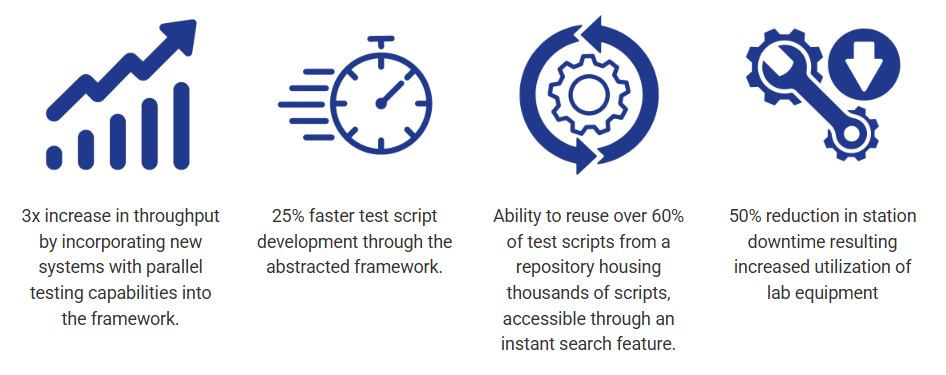
In summary, the partnership with Soliton marks a transformative chapter in semiconductor reliability testing for the customer. From building on the legacy framework and process to ushering a new cutting-edge innovation in LabVIEW, our collaboration has streamlined processes for engineers.
Explore our “Case Studies” section for more transformative success stories showcasing Soliton’s strategies and insights for overcoming obstacles and driving efficiency.