

What is Forward Deployed Engineering?
Our forward-deployed engineers work inside your environment rather than behind a requirements document. We learn your workflows firsthand, build in the tools your team already uses, and carry the intended outcomes through deployment, not just delivery. We understand user personas, observe real interactions, and tune the software to the workflow to improve adoption.
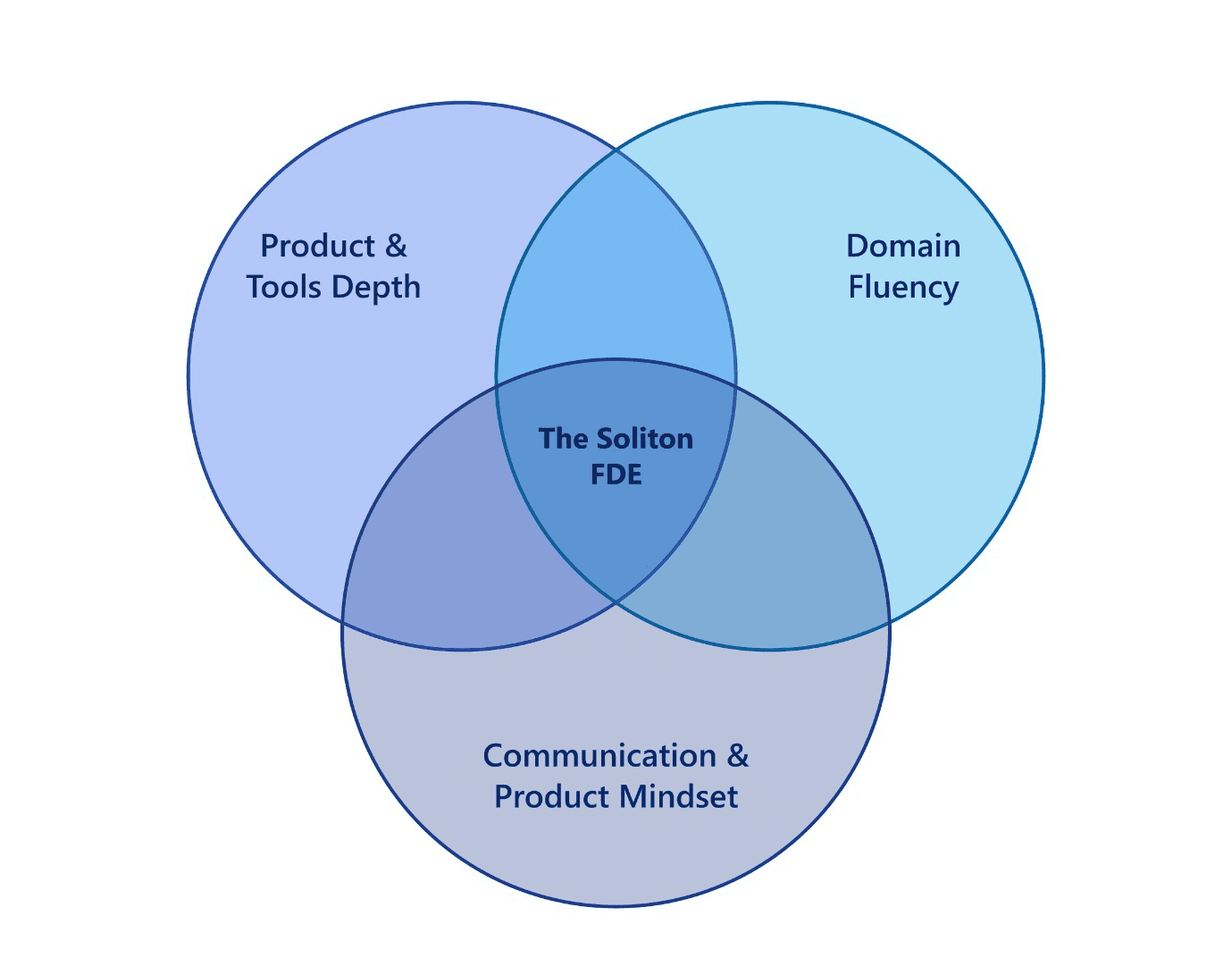
Doing that takes three skill sets at once: depth in the product and tools, fluency in your domain, and the communication and product mindset to work inside your team. The Soliton FDE sits at the intersection.
As customer success teams, our engineers have sat inside validation labs and engineering teams at the world's leading semiconductor and device companies, staying until the software works in production and in user workflows.
For teams taking AI from pilot to production
Models that impress in a demo stall in production because they were never grounded in the team's real data, real edge cases, and real workflow. Most AI initiatives fail exactly here, in the last mile between pilot and daily use.
Forward deployed engineering is how that gap gets crossed. We bring fluency in the models and the domain the AI is applied to, whether that's generating test programs, analyzing measurement data, or automating validation reporting. And most importantly, we bring the communication and product mindset, embed with your team, ground the AI to your actual workflows and data, and iterate on-site until it holds up in daily use, with your engineers able to trust what it produces.
Where we deploy
01
Post-Silicon Validation
02
Test & Measurement Automation
03
Engineering Applications & Tools
04
AI in Engineering Workflows
05
LabVIEW & NI Ecosystem
06
Measurement Data & Analytics
How an engagement runs
01
Short outcome-driven sprints
Every engagement starts with a pilot, typically three to four months, with a defined outcome. We treat it the way a startup would: reach the target, measure, and iterate on real feedback.
02
Deploy the way your work demands
We deploy engineers at your site full-time across all phases, or during crucial stages like discovery, deployment, and scaling, while development runs offsite. With teams across the US and India, work continues around the clock.
03
Scale on evidence
At the end of the pilot, you have working AI agents in your workflow, measured against the outcome we set, and a documented blueprint for scaling it. Then we decide the next step together, on evidence.
Why Soliton
- Every engineer we deploy draws on product depth, domain fluency, and a product mindset.
- Teams across Asia, the US, and now Europe, keeping work moving around the clock.
- A model we have run for years as customer success teams inside customer labs, before the industry named it.
- Outcome-driven by habit: defined targets, measured returns, and iteration on real feedback.
FAQ