

Timing Accuracy: Why Protocol Interfaces That Pass Compliance can Still Deliver Wrong Data
An interface can pass every compliance test and still deliver the wrong value. The device transmits the correct value, but the receiver captures a different one. The frame is properly structured, the parity bit is valid and the device responds, so no error flag is raised and no counter increments.
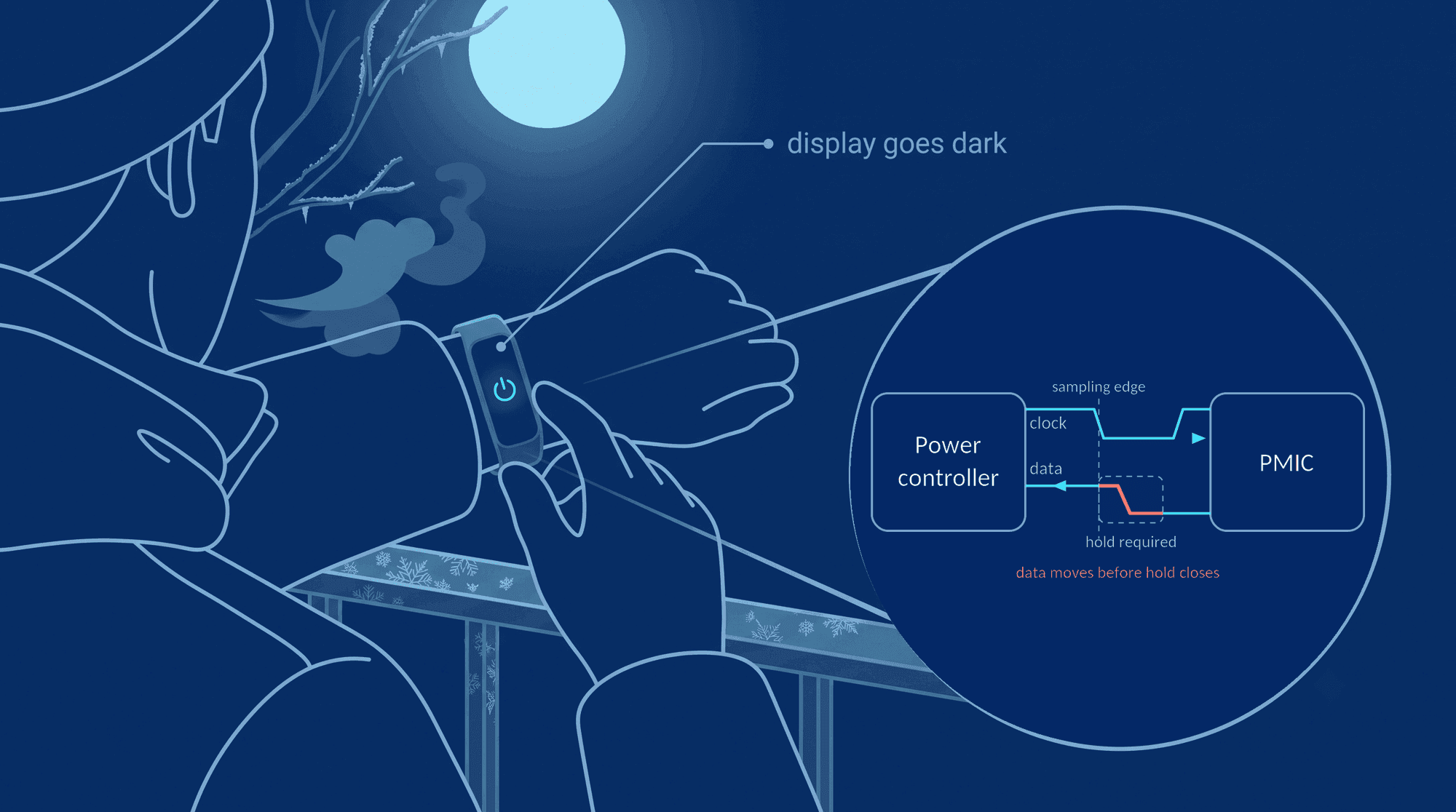
A fitness band showed how costly this can be. About 1 percent of units came back from the field because they were switching themselves off. These were hardware resets, not crashes or freezes.
The firmware team checked the watchdog timer and the system logs and found nothing. The power team recalibrated the fuel gauge over temperature and shipped the fix. The return rate did not move. Eleven months in, a unit was caught mid-failure on the bench with its PMIC registers dumped. The power controller had read a cell voltage far below the real one and shut the system down to protect the battery, which is exactly what it is designed to do.
The value was wrong, but no error-detection mechanism on the interface reported it.
This post follows that failure end to end: what the interface was doing, why its timing held at room temperature and vanished in the cold, why nothing flagged it, and how the team finally confirmed the cause on the bench.
How the timing margin disappeared
The interface, and the window it depends on
The band's power controller talks to its PMIC over a two-wire interface: one clock line, one bidirectional data line, both push-pull with every edge actively driven. The power controller owns the clock. On a write, it drives both lines. On a read, it drives the clock and the PMIC drives the payload.
This asymmetry is what caused the failure. On a write, clock and data leave the same die on the same supply, so the two lines stay aligned. On a read, they come from different chips, and nothing keeps them aligned.
The power controller samples the data line on a clock edge. For that sample to be right, the line must already have reached a valid logic level before the edge, and must hold that level for a short interval after it. Together, these two intervals make up the sampling window. The margin is the spare time on each side: how much earlier than required the data arrives, and how much longer than required it holds. The two are budgeted separately.
Normal conditions, and then the cold
At room temperature, the PMIC's launch delay is comfortably longer than the power controller requires. The data line settles well before the sampling edge and holds well after it, so the controller captures the correct bit. Every read returns what was sent, and bring-up and compliance testing both pass. Passing confirms that the interface works under these conditions. It does not show how much margin is left.
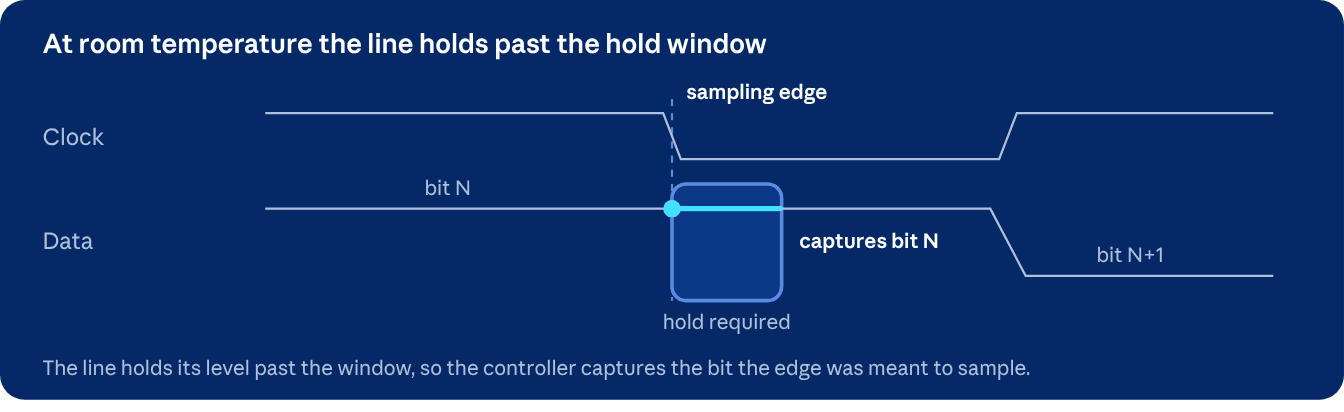
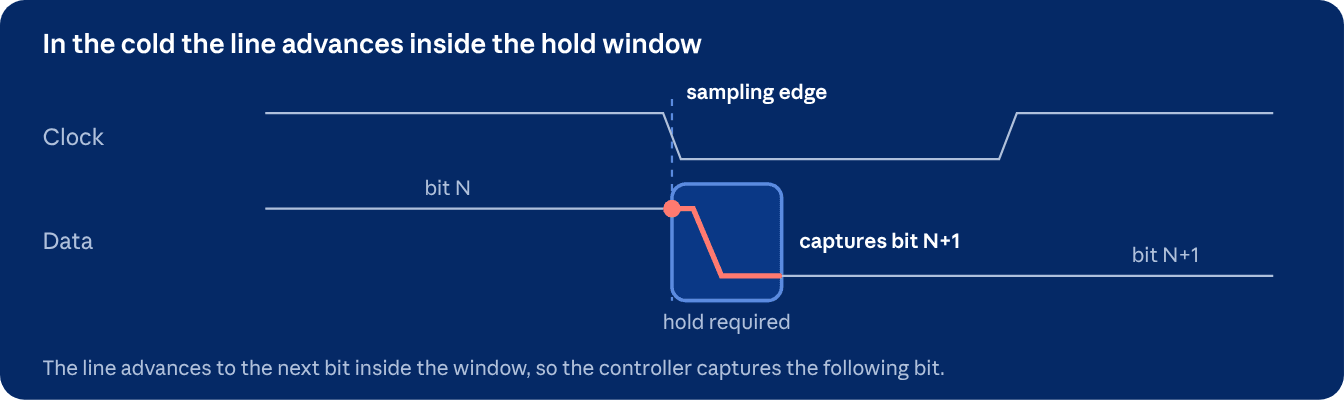
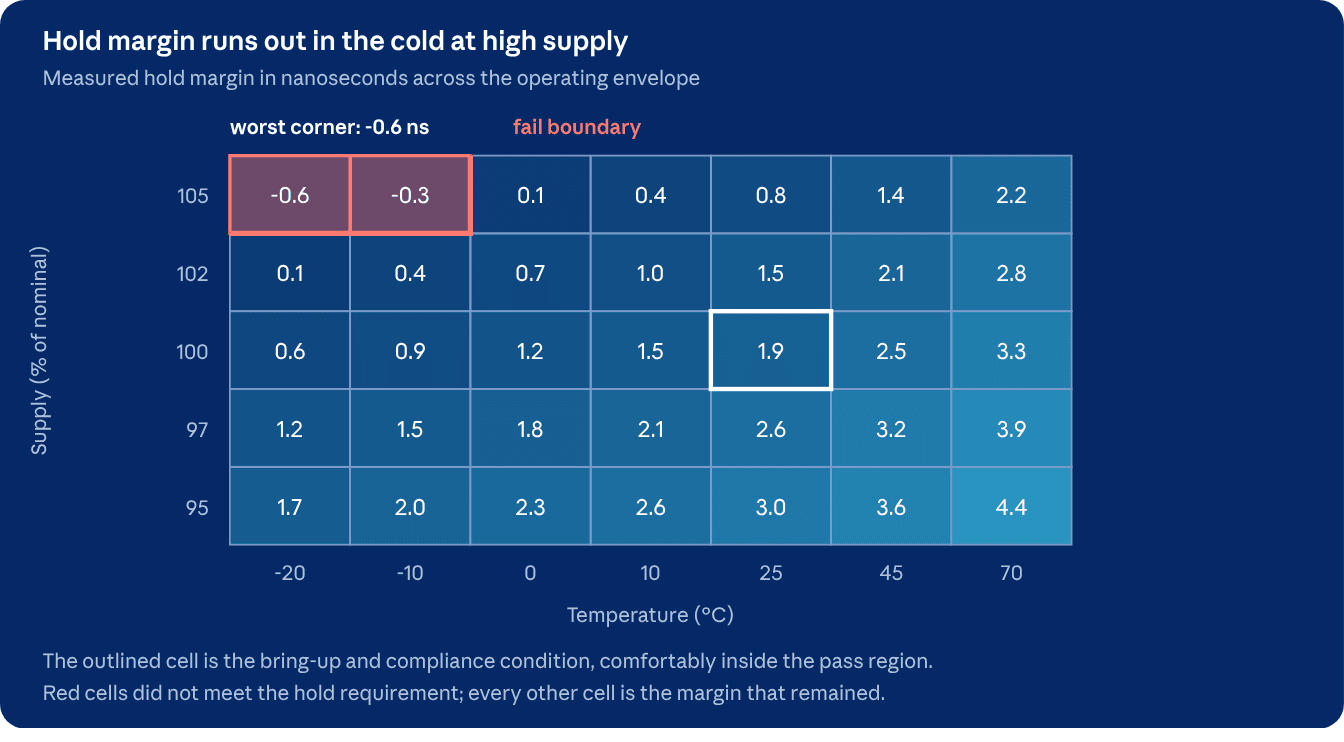
On a cold morning with a freshly charged battery, two things change, and both shorten the launch delay. First, the PMIC's I/O voltage comes from the battery, so straight off the charger it is at the top of its range. A higher supply makes the output driver stronger, and a stronger driver puts the next bit on the line faster. Second, the PMIC switches faster as the temperature drops. As a result, the data line moves to the next bit sooner after the clock edge than it ever did on the bench.
Together, those conditions lead to a hold violation. The power controller's input stage needs the data line to hold its level for a few nanoseconds after the clock edge. The line had already moved on, so the controller captured the next bit instead.
Why nothing flagged it
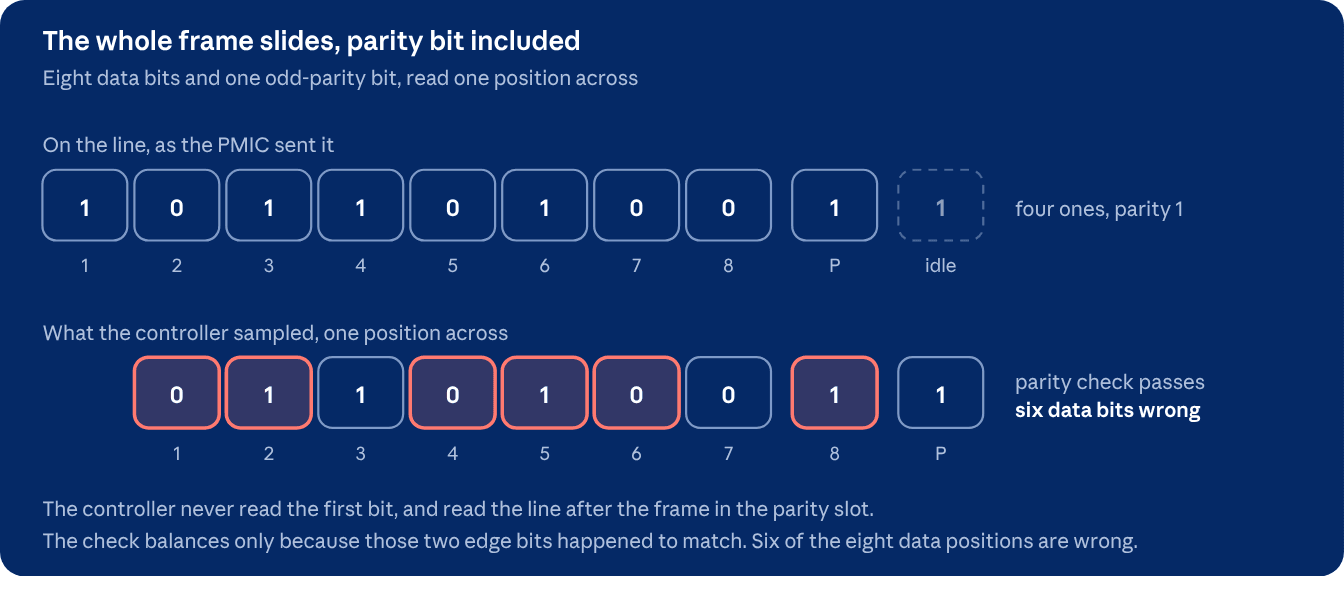
The framing was intact, and the response was genuine: the PMIC received a valid command and replied. Parity needs more explanation. The PMIC sent the right bits, but because of the hold violation, the controller read them shifted by one position. The first bit is lost, the parity bit shifts into the payload, and whatever was on the line after the frame lands in the parity slot. The parity check passes at least half the time. When it does, the frame is accepted, the corrupted payload is passed on, and nothing on the interface can flag it.
Confirming it on the bench
With no error to trace and no setting that would fix it, the team had to put a unit back into the conditions the returns pointed to. The team held it cold and at the top of its supply range, then swept the data-line timing against the clock in small steps until the interface stopped working. The result was consistent: the interface failed at the same point on every pass, a sharp boundary rather than scattered errors. At that corner the measured hold margin was under 1 ns, and it had been under 1 ns since the first prototype. Nothing had drifted or degraded. The design had passed every test it was given, but its margin had never been measured across the operating conditions that mattered.
The sweep did not change the hardware, but it changed what the team knew about it. They now had the margin at the worst corner as a measured number rather than an assumption, and a map of where in the operating envelope the margin held and where it ran out. That was the root cause: a timing violation that appears only at the extremes of temperature and supply, which is why nothing before it had explained the returns.
Conclusion
Timing accuracy is not just a box to tick at the end of validation. It is the condition under which the data on an interface can be trusted, yet no protocol reports it, and error detection catches only some errors. An interface with no margin passes the same tests as one with plenty, and behaves the same way until conditions push it past the limit. By then the wrong value has already been acted on.
The band's interface passed bring-up and compliance testing, but it did not have enough margin. Nobody had asked how much margin was left once the supply, temperature and the board had taken their share, so nobody knew the answer was under a nanosecond. Passing a test is not enough. Budget setup and hold separately before bring-up, sweep each parameter to failure across the conditions the product will actually meet, and record the margin that remains as a number.
Here is a question to take back to your own bench: at the worst corner your product will ever see, how much timing margin does your interface actually have, and can you put a number on it?
Putting a number on that margin is hard. The sweeps take time to build, the test conditions are many, and a nanosecond is difficult to resolve on the bench.
If that is where your validation stalls, reach out to my team.