


How Automated Protocol Validation Insures Against Schedule Risk
First silicon has arrived. The design is frozen, the mask is made, and the schedule now hinges on one question: do the chip's communication interfaces behave the way the specification says they should?
This blog looks at why post-silicon protocol validation is so much harder than teams expect, where the time really goes, and how automation turns weeks of bench work into a repeatable run any engineer can trust.
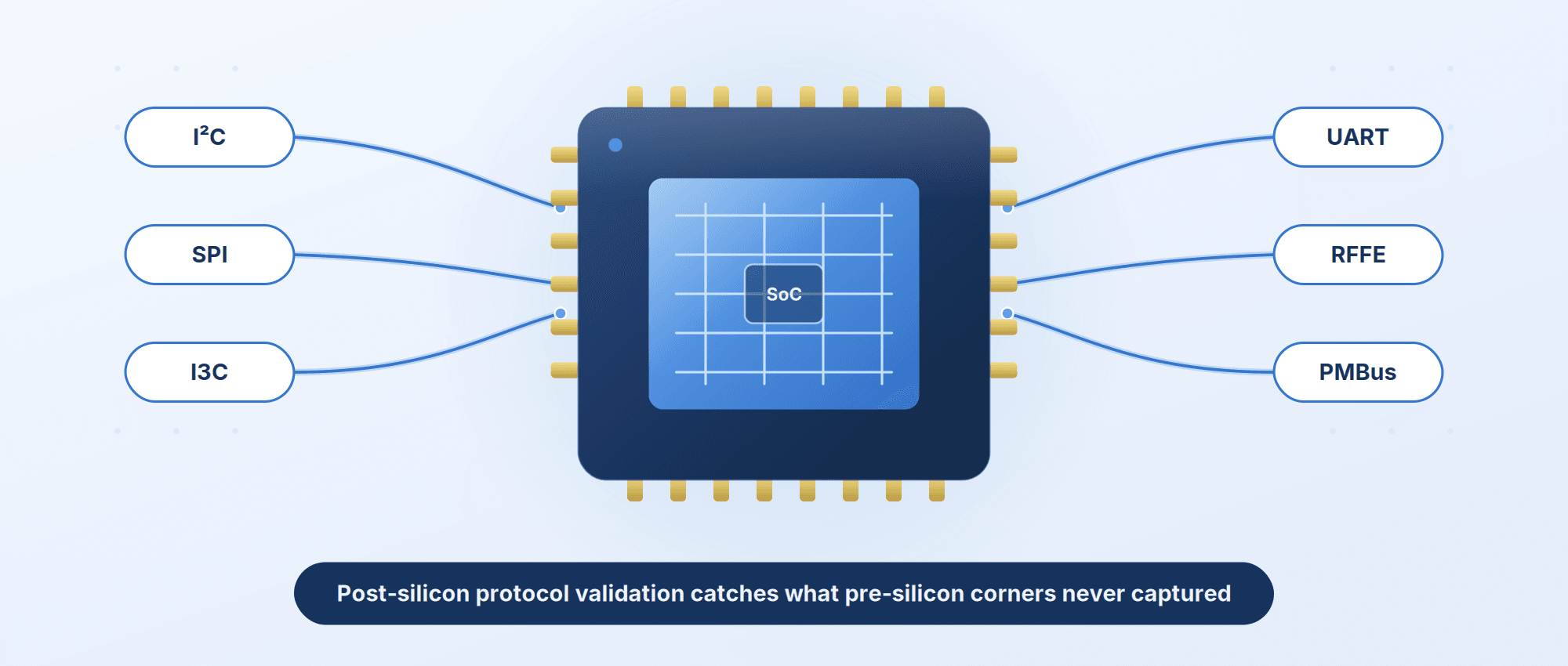
Everything before the first silicon arrives at the bench was reasoned from a model of the design. Real silicon carries what that model could not fully capture: real process spread, real parasitics, real package and board effects. The communication interfaces (I2C, SPI, I3C, UART, RFFE, SMBus, PMBus) are where much of that gap shows up. A design that closed cleanly in simulation can still miss a hold-time margin, breach a voltage threshold or mishandle a bus fault on real silicon.
Post-silicon protocol validation is the step that catches these failures before your customer does. It is also the step most likely to slip your schedule, because of how much ground it has to cover.
The Pressure Point - Sweeping Every Corner, Unit and Revision
By the time protocol validation begins, the interfaces are usually already “working” in the obvious sense. Data moves. The device enumerates. A quick smoke test passes. If validation were only about confirming that normal traffic flows, it would take an afternoon.
The trouble is that a communication interface has to maintain compliance across its entire operating envelope, and the failures that matter almost never appear at nominal conditions. They appear at the edges: at the low end of the supply rail, at high temperature, at a slow process corner, on an outlier unit, at the maximum rated clock speed. A device that passes every check at 25 °C and 1.0 V can still violate hold time at 85 °C, well within its specified range.
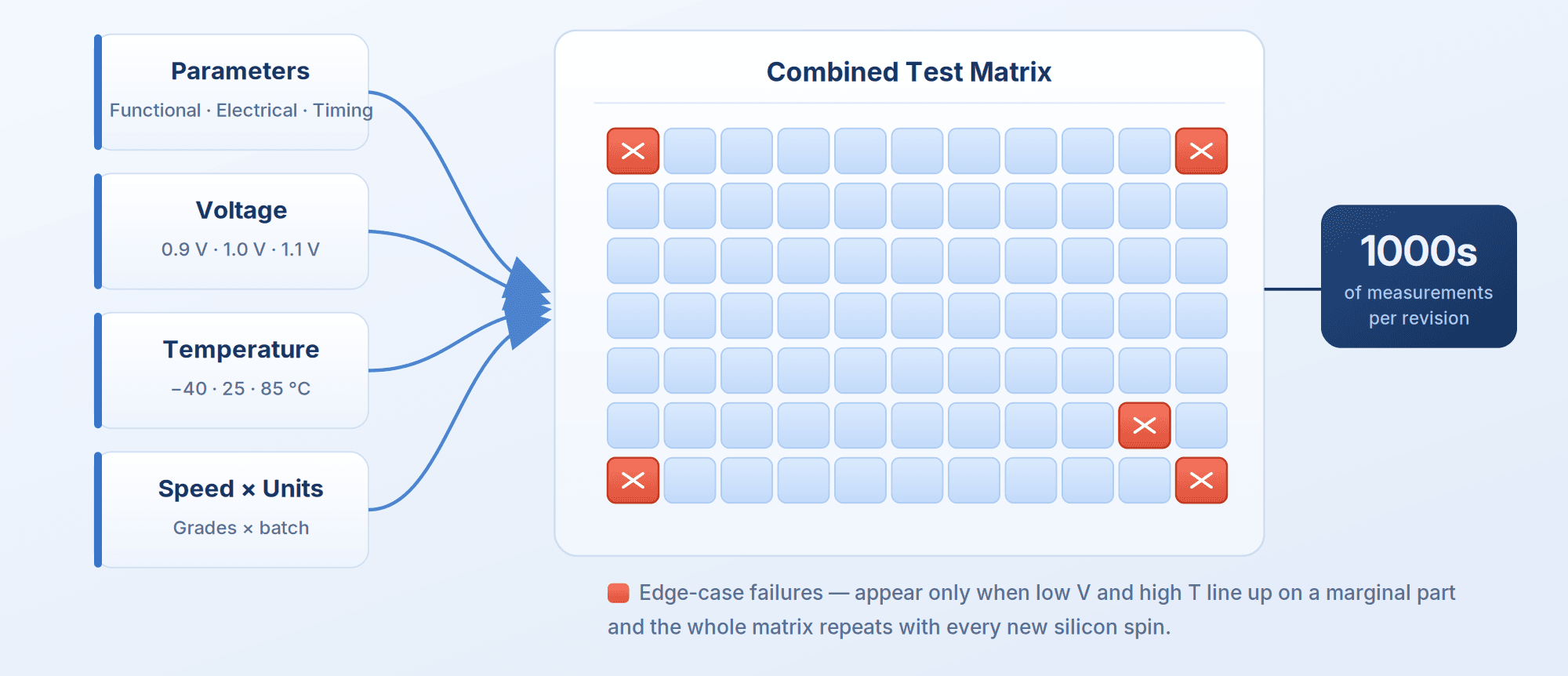
So real validation is never a single pass. It is a full pass across every class of parameter the specification defines functional behaviour, electrical thresholds, and timing margins alike — and each of those has to be exercised across voltage, across temperature, across speed grades, and across multiple units. Often the conditions have to be combined, because the failure that hides at nominal voltage only reveals itself when low voltage and high temperature line up on a marginal part. It is not one measurement repeated; it is a whole space of functional, electrical, and timing checks that all have to hold together.
A handful of parameters, across several voltages, a few temperatures, a couple of speed grades, over a batch of units, is already thousands of measurements. And the entire matrix repeats with every new silicon revision.
The Happy Path Is the Easy Part - Faults Are the Real Test
Even a complete sweep of normal operation only tells half the story. Protocol specifications describe far more than how a device behaves when everything goes right. They define, in detail, how it must behave when things go wrong: how it detects a corrupted transaction, how it flags a fault, how it recovers from a glitch on the bus, how it cancels a half-completed command so shared configuration is never left in an inconsistent state.
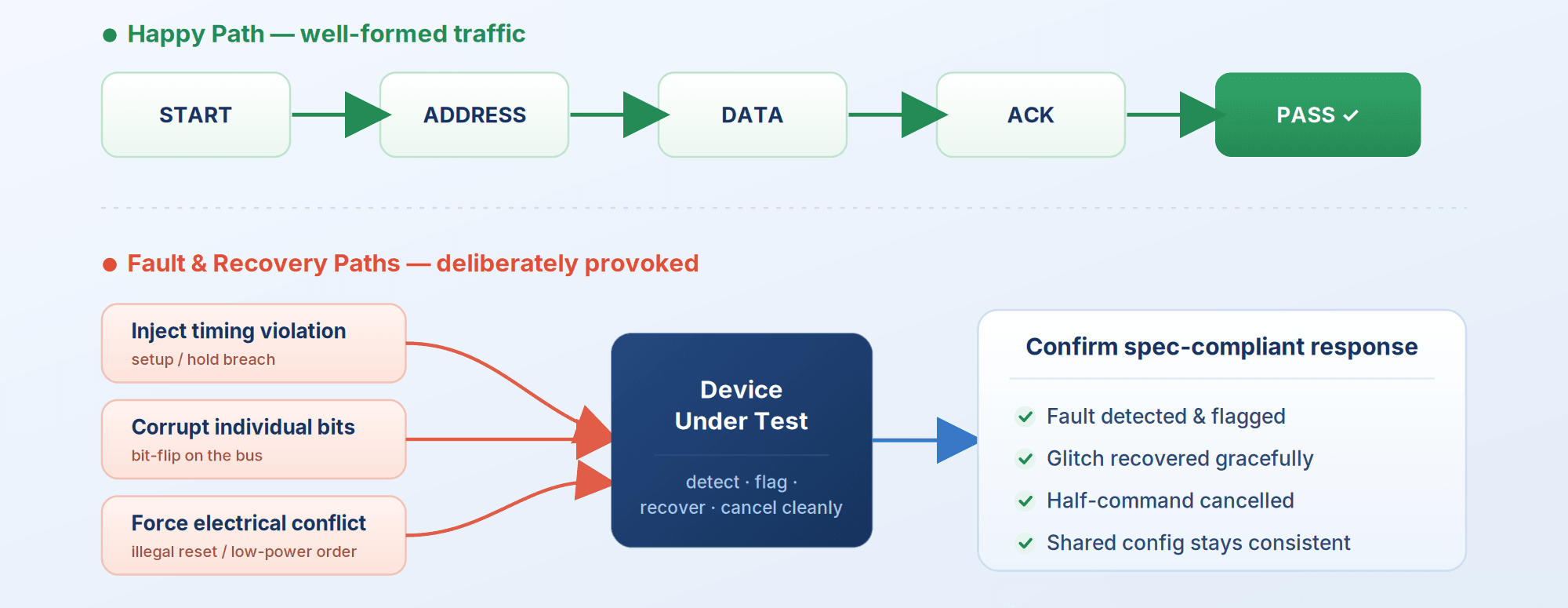
These recovery paths are exactly the behaviour that normal, well-formed traffic never exercises. A device can sail through a functional test suite and still mishandle the very fault conditions its specification was written to make survivable — because those conditions simply never occurred during the test.
Validating them properly means deliberately provoking them: injecting timing violations, corrupting individual bits, forcing electrical conflicts on the bus, sequencing resets and low-power transitions at the worst possible moments and in illegal orders — then confirming the device responds the way the spec demands. This is essential work, and it further multiplies the validation task. Every corner case is another set of conditions to set up, run, observe, and log.
Why the Traditional Approach Doesn't Keep Up
Faced with this, teams have historically reached for one of two options, and both struggle at scale.
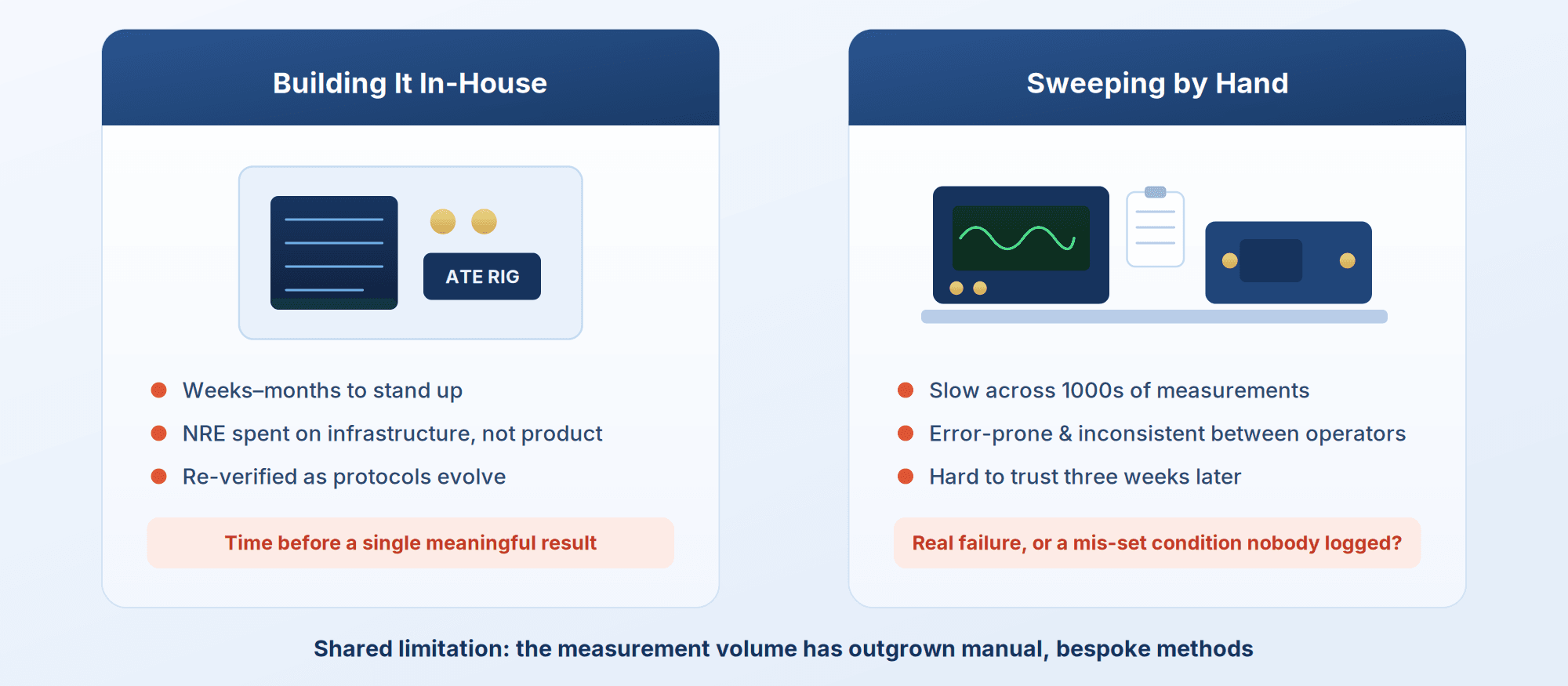
- Building it in-house. A custom protocol exerciser, or a rig built around ATE, can do the job — but standing it up takes weeks to months of engineering effort before a single meaningful result appears. That is time and NRE spent on test infrastructure rather than on the product, and it has to be maintained and re-verified as protocols and requirements evolve.
- Sweeping by hand. The alternative — an engineer at the bench, changing conditions and recording results manually — does not survive contact with the numbers above. At thousands of measurements per revision, manual sweeping is slow, error-prone, and inconsistent between operators. Worse, it is hard to trust: when a result looks wrong three weeks later, was it a real device failure or a mis-set condition that nobody wrote down?
Both approaches share the same underlying limitation. The volume of measurement required to properly characterize a modern interface has outgrown the capacity of manual, bespoke methods to deliver it consistently.
Automation Is What Makes Post-Silicon Validation Tractable
The way out is not to test less. It is to make the full sweep something you define once and replay on demand.
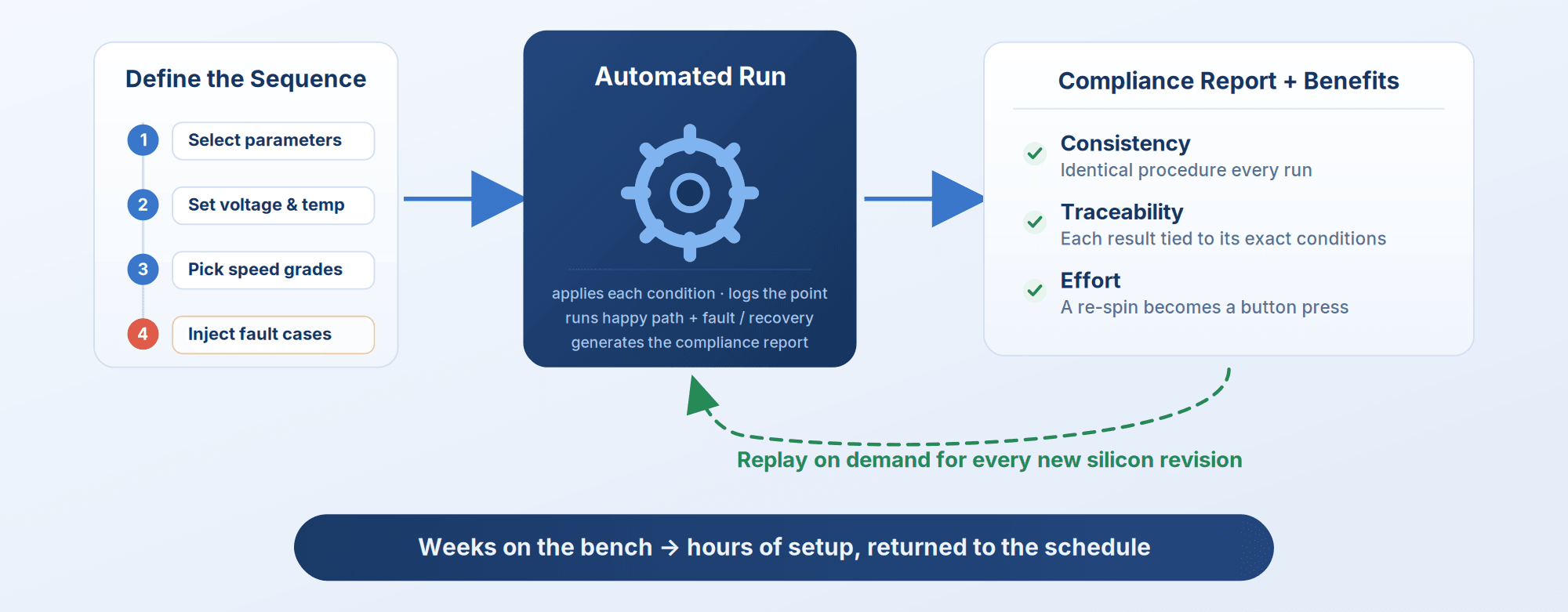
A good automated validation setup lets an engineer specify the sweep sequence a single time — every parameter, every corner, every fault to inject — and then runs the entire matrix on its own. It applies each condition, logs the exact operating point against every result, exercises the corner cases and recovery paths alongside the happy path, and generates the compliance report at the end. What changes is not just speed but the character of the work:
- Consistency. Every run follows an identical procedure, so results are comparable across units, across corners, and across silicon revisions.
- Traceability. Each measurement is tied to the precise conditions that produced it, so you can trust, reproduce, and debug a surprising result rather than second-guess it.
- Effort. Re-validating a new silicon spin becomes a button press rather than a fresh week on the bench — which matters, because there is almost always another spin.
That last point is where the schedule impact lives. When validating an interface across its full envelope takes hours instead of weeks, a re-spin no longer means restarting the entire characterization effort by hand. Time that used to disappear into setup and manual sweeping returns to the schedule.
Conclusion
Post-silicon protocol validation is where a design finally meets physical reality, and where the marginal, condition-dependent failures that quietly passed every earlier check get their last chance to surface before a customer finds them instead. The difficulty is not conceptual — engineers know exactly what needs testing. The difficulty is volume: an operating envelope that has to be swept in combination, a set of fault and recovery paths that normal traffic never touches, and a matrix that repeats with every silicon revision. Done by hand or on a custom rig, that volume is what turns validation into a schedule risk.
Automation is what makes it tractable. When the full sweep is something, you define once and replay on demand, thorough validation stops being the step that threatens the ship date and becomes the step that protects it.
If you're wrestling with how to validate your interfaces across their full operating envelope without losing weeks to the bench, or you'd like to see how PVS handles your specific protocols, talk to us. We'd be glad to show you what a few hours of setup can change about your schedule.
Author: Puviyarasu Sakthivel