


Executing an Industry first LAB to FAB Standardization with Analog Devices Inc.

Analog Devices, Inc.’s (ADI) partnered with Soliton for a Lab to Fab standardization initiative aimed at achieving significant efficiency improvement across the lifecycle. Soliton developed a comprehensive, first-of-its-kind solution, including a low-code workflow automation interface that has enabled global teams to collaborate efficiently, optimize test workflows, and achieve significant quantitative and qualitative benefits.
“We needed to develop standardization in the evaluation labs, and Soliton has been instrumental in that process over several years, working directly with individual lab teams and developing a common framework that is now supporting many diverse teams. We have seen the tools as particularly useful during company mergers as it is scaled for global use within the company.”
– Sr. Director – Test Enablement Group, Global Operations and Technology, Analog Devices
The Customer Requirement
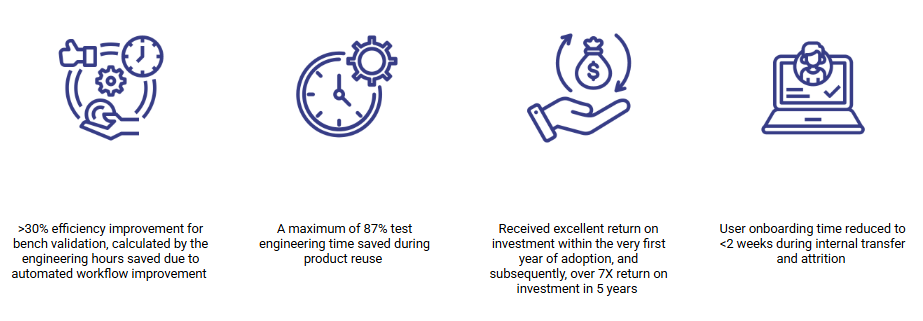
Analog Devices, Inc (ADI) has been a pioneer and a leader in the semiconductor industry for well over half a century. The Senior Leadership from ADI came up with an ambitious goal to achieve over 30% efficiency improvement through a first-of-its-kind Lab to Fab standardization initiative and chose to partner with Soliton to build this solution.
Solution
Working closely with the stakeholders at ADI, Soliton understood the process and technology in place. Soliton conceptualized an end solution and defined the sequence to approach the solution implementation. This solution was implemented in a record time, combining technology, processes, and people support.
,,
Implementation
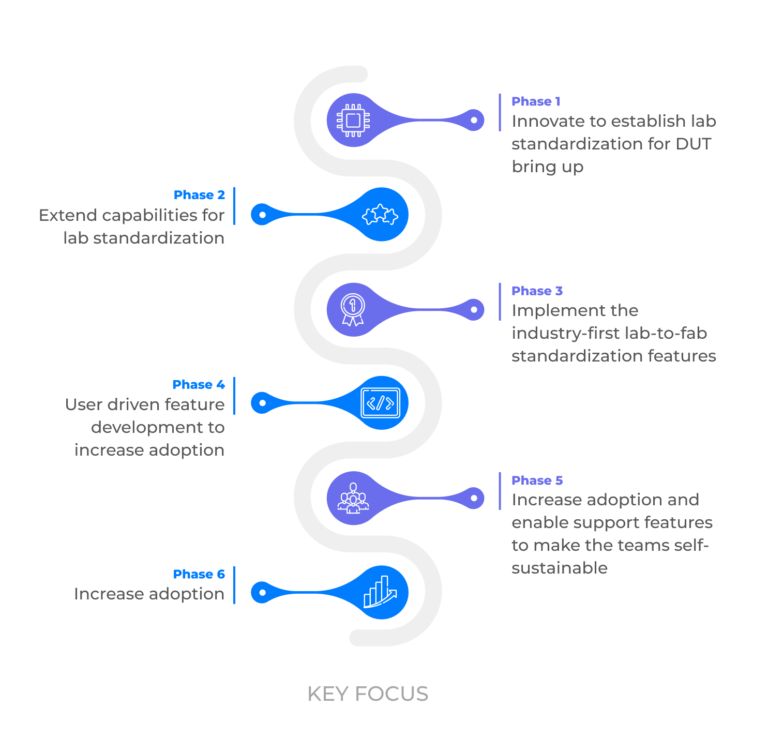
Soliton developed this solution in a phased manner, starting first by identifying what gives the most ROI to ADI, and then by following a user-defined roadmap.
Quantitative Benefits of the Engagement
In addition to the quantitative, measurable outcomes, the engagement also resulted in qualitative benefits. Some of the benefits include:
- Quality improvement with increased test coverage.
- Validation schedule compression
- Efficient automation increases the productivity of the validation cycle.
- Increased test coverage helps identify Si bugs in the first iteration, thereby avoiding multiple design and package changes, resulting in faster time to market.
- Effective lab asset utilization.
- Increased collaboration and reuse among globally distributed teams through standardization and a central repository.
- Effective internal attrition management and onboarding cost.
- Early identification of Si bugs using Pre-Silicon simulation models in the bench.
Global Adoption of Standardization

Summary
Soliton assembled and reorganized a cross-functional team that took care of the project’s needs as it progressed from stage to stage. This ability to quickly map customer requirements and reorganize the team to come up with creative solutions has been instrumental in the initiative’s success.
As more and more test engineers continue to adopt this central repository-driven automation framework, it has fostered standardization and collaboration, facilitated the seamless movement of engineers between different groups and functions, and enabled faster release to market.